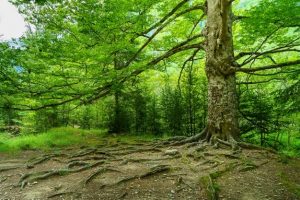
Some scholars have noticed that in Jaufre there is more than one wasteland. He travels on from Augier’s castle through an empty land, where there are no people or castles, although there is a field of rich grass where he can allow his horse to graze, and finally reaches an encampment of tents and knights. Augier has told him not to talk to anyone there, although we never discover why, but he hears comments from some of the knights suggesting that once again he is riding into trouble. The “castle”, in common with many medieval castles, is a fortified town. The encampment surrounds it, but the town itself is deserted and within this town Jaufre finds the palace with the residential accommodation. Jaufre leaves his shield and lance with his horse and goes through a small, decorated door to find a wounded man on a bed, with two ladies attending him, both weeping.
This is one of the most intriguing scenes for me. When I first read Jaufre I thought there must be some connection between this scene and a piece of verse known as the Corpus Christi carol, first written down in 1504 in Middle English:
He bare hym vp, he bare hym down,
He bare hym in to an orchard brown.
Lully, lulley, lully, lulley!
Þe fawcon hath born my mak away.
In þat orchard þer was an hall,
Þat was hangid with purpill & pall;
Lully, lulley, lully, lulley!
Þe fawcon hath born my mak away.
And in þat hall þer was a bede,
Hit was hangid with gold so rede;
Lully, lulley, lully, lulley!
Þe fawcon hath born my mak away.
And yn þat bed þer lythe a knyght,
His wowndis bledyng day & nyght;
Lully, lulley, lully, lulley!
Þe fawcon hath born my mak away.
By þat bedis side þer kneleth a may,
& she wepeth both nyght & day;
Lully, lulley, lully, lulley!
Þe fawcon hath born my mak away.
& by þat beddis side þer stondith a ston,
“Corpus Christi” wretyn þer-on.
Lully, lulley, lully, lulley!
Þe fawcon hath born my mak away.
It has resonances with the Fisher King in the Grail romances, as well as a possible Christian interpretation. The man who lies on the bed is, for the moment, unidentified in Jaufre, but Jaufre learns that he is a good and noble lord, much loved by his people, and it is the thought of his torment and torture which drives people to their mourning, lamentation and hair-trigger tempers. Now that I have done more research, the figure on the bed with the attendant women is also similar to a tale told in Sicily and set down by Gervase of Tilbury in his Otia Imperialia, a book full of tales and other notes, written for Otto of Brunswick (a grandson of Alienor and Henry II) in around 1210. Gervase had been at the court of William of Sicily and his wife Joan (another daughter of Alienor and Henry II) which is probably where he heard the story. The story is of a squire looking for a runaway horse on Mount Etna, who finds an underground palace, where he discovers the wounded Arthur lying on a richly draped bed, being looked after by his sister Morgan le Fay. While the wounded knight in Jaufre is not a king, or Arthur, and the palace is not under a mountain, it is, I believe, more likely that this is the source of the story rather than a Grail tradition. Gervase later in his life owned a villa near Arles, where among other guests it is recorded he entertained the grandfather of James I of Aragon, Alfonso, and so it is quite likely the tale reached Aragon by that route.
The cause of the grief and lamentation seems a little underwhelming after all of the build-up, but at least Jaufre now has the information he needs. He also has a spare week. And so he goes off on a side-quest, following a track into a forest.
This forest, described later as another wasteland, is where he meets two extraordinary characters and a hermit. The first encounter is with a hideous old woman, dressed in expensive and beautiful clothes. She’s sitting at the foot of a pine tree and feeling the heat of the day. Ugly old crones come into a number of tales, often seated at crossroads, and generally with an answer to a question or a solution to a problem as long as the hero kisses them, or marries them. Not, however, in this case. There is no suggestion that she wants Jaufre to kiss her but instead she stands up and reveals that she isn’t just ugly, she’s also a giant. Jaufre decides to disregard her warnings, and this leads him directly into the path of the next character. Who seems at first sight to be a Monty Python-esque Black Knight, continuing to fight despite multiple severe wounds, but as these wounds heal up almost immediately it is clear he is not a comic creation at all. One clue to his non-human identity is the sounds he makes when he is fleeing from the hermit’s holy water and crucifix. Rather like the sound of thunderstorms when Jaufre is on the tail of Estout de Verfeuil (whose magical armour Jaufre is now wearing), and the violent storm which erupted after the magic spell on the leper’s house was released, this is a magical storm, and the mysterious Black Knight turns out to be a demon, summoned from hell. There was no way, the hermit tells Jaufre, that he could be defeated except by the “weapons and arms of Jesus Christ”. This episode turns out to be a turning point for Jaufre. He has met an enemy he can’t defeat, but from here on his conviction that he is right is fuelled by the sense that he has been sent by God. Interestingly enough, this is a point of view expressed by James I of Aragon in his memoirs (La Llibre del Fets), based on his own survival of a decidedly difficult childhood. Jaufre, like James, is on a mission from God. Incidentally, after watching The Mandalorian I can’t help seeing the ways in which the modern writers have taken on board elements from medieval romances, and when the hermit tells Jaufre to remove his helmet I’m slightly surprised that he does!
The hermit fills in some answers to some outstanding questions, and so now we find out the connection between the ugly old woman and the giant leper, and in the next chapter we meet her other son. He is behaving very like his brother, having snatched up a maiden from a garden visit with her mother (and this is another reference to social behaviour which is slightly surprising – where was this garden, and who did it belong to?), and is preparing to ravish her. She behaves very like the maiden in the leper house episode and throws herself to the floor to pray, while Jaufre again slices upwards to do as much damage as he can while dodging the entire tree the giant is wielding (instead of the club in the leper house). He is knocked unconscious again, but luckily the giant is dying. Why doesn’t the maiden recognise Jaufre? Possibly because he is wearing his helmet – but the interchange I like here is Augier’s daughter finally realising it is their guest from a week ago and pointing out that for once the formal acknowledgement of “being at your service” has produced a practical result.
In Chapter 9, then, Jaufre gets some answers to his questions and information about how to find Taulat. In Chapter 10, there is the odd supernatural encounter with a demon (you will recall that he had thought the soldiers in Brunissen’s castle were demons, but this is a real one). And Chapter 11 completes the information on the giant family, although it’s a much shorter interlude. It also gives Jaufre a reason to return to Augier’s castle. Because it has so many similarities to the other fight with a giant it feels a bit of a make-weight addition to the story, and as a storyteller I am intrigued by the parts of the tale which are not intrinsic to the main plot. Were they once more important stories in their own right, or is the storyteller filling in time for some reason? We are unlikely to ever know the answer to this.