Chapter 15
Brunissen and Jaufre are now happily agreed about their love and their plans, but there are a couple of formalities to be observed. One of these is to have the formal permission to marry from Melian de Monmelior, Taulat’s former prisoner. There is some missing detail in “Jaufre”, as it is never made clear exactly what the relationship is between Brunissen and Melian, although this section of the story makes it clear he is the overlord for her lands. Which goes against what was said when Brunissen is first introduced into the story, when the narrator says she has no family and she is in sole control of her castles and lands. In some later re-tellings of the story, such as the chapbooks written in Spanish which were printed and re-printed up to the early 20th century, Melian is described as Brunissen’s uncle, which makes sense, and suggests the 13th century telling of the story may have simply forgotten to mention this.
Melian’s arrival is announced and Jaufre and Brunissen ride out to welcome him. Before they meet him, they encounter the distressed maiden who has been turned away from Arthur’s court without any assistance (which of course contradicts everything we have been told about Arthur’s court). When she meets Jaufre and Brunissen she provides the listeners with a useful recap of all of Jaufre’s triumphs so far, while Jaufre reminds us of the names of the different knights who should have been able to come to her aid. Brunissen reacts in a human, honest way to the notion that her newly-found love might go off with a strange woman and risk his life, and it always makes me smile at her speaking “very sweetly but between her teeth”. Jaufre is a little more circumspect but rather unhelpfully suggests the unfortunate maiden should simply put her trust in God. Melian arrives and we see no more of the maiden. There are instead some fine festivities, and Brunissen sets about persuading Melian to suggest she does precisely what she has always intended to do. You will notice that Jaufre is at first very correct in how he answers Melian’s question about love, as he is well aware that in terms of society and wealth he ranks far below Brunissen, but when pushed about the nature of love he speaks honestly. It is not a remote “courtly love” that he feels, but the real deal. We are repeatedly told that Brunissen is a match worthy of an emperor, and we are never told about Jaufre’s family background apart from the name and reputation of his father. Melian and Jaufre appear to be good friends, able to joke with each other (I have a mental image of Melian nudging Jaufre in the ribs when talking about *that* kind of love), and yet they have not had much time to establish this friendship within the story so far.
Chapter 16
This is a fascinating piece of storytelling on a number of levels. The setting is an enormous lush and beautiful meadow (reminding the listener of Brunissen’s orchard and garden), with a “fountain” or spring at one end. It is hard to tell whether this is a natural spring with a pool, or something more architectural (in which case we have no idea who might be responsible for it). The entourage are busy setting up tents for the night when a woman’s cry for help is heard, reminding the listeners of Arthur’s adventure at the start of the tale, and, just like Arthur, Jaufre resolves to go and see what is wrong. And is pushed into the water, with a definite sense of slapstick rather than heroism. The image below is an engraving by Gustav Doré from “Les Aventures du Chevalier Jaufre et de la Belle Brunissende” by Jean-Bernard Mary-Lafon (1856), while the image below that is from the late 13th century manuscript in the Bibliothèque Nationale. Neither are particularly realistic!
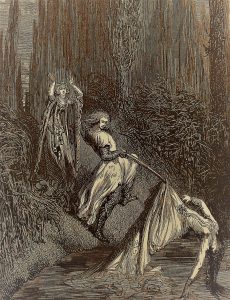
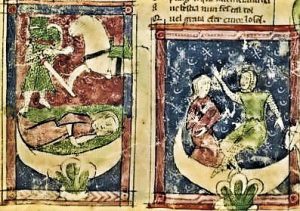
Immediately after Jaufre’s immersion in the water, the narrator presents us with a remarkable selection of funeral elegies, starting with the grief of his horse, and swiftly followed by the seneschal, Melian and Brunissen. Throughout the tale there are numerous depictions of extreme grief, but this is by far the longest passage of mourning and lamentation. Brunissen tries to drown herself, but her pragmatic seneschal pulls her out by her hair (I love this man!). Male grieving, as shown here, is also found in other literature of the time (and earlier), for example in the Chanson de Roland and Beowulf, although it may seem overwrought and unlikely now, but I think that the comic intent within this story is made clear when the horse is the first one to be affected. There is some good poetry in the elegies, although of course the listener will already suspect that Jaufre is not, in fact, dead – and then the Archbishop Gales delivers some general hollow platitudes. Melian eventually suggests that they send a message ahead to Arthur, who is bound to know what to do as he has had adventures!
Meanwhile Jaufre, weighed down by his armour, travels quickly through the water and finds himself in another world below the water. There is a lot to say about fairies inhabiting wells, or fountains, or rivers, and sometimes enticing men into the water for various purposes, and there are folktales from various cultures about a land under the water. Some scholars have tried to draw parallels with the fountain in Yvain or the Welsh Owain, but the motif is treated very differently, comes at a different place in the story and there is no underwater world, and so these comparisons are not very helpful. We don’t discover the name of the maiden who has played this trick on Jaufre until later on, but it is worth noting that her land is beautiful and rich, but devoid of people and ravaged by warfare, a little like the forest in which Jaufre had met the demon and the mother of the lepers. She justifies pushing Jaufre into the water by her desperation to find a champion, having been turned away by Arthur’s court and by Jaufre himself. Her enemy is Felon d’Albarua (his name possibly comes from the same root as Oberon), and his villainy is clear from his ugliness, as well as his complete lack of good manners. His wonderful bird, which appears to hypnotise its prey (without the medieval author knowing the word “hypnotise”), might be a reference to a conflict between two barons of James I of Aragon who were ready to fight over a goshawk.
Small details to note in passing – Jaufre attends church, so although this is a magical location the people there still go to church, and he puts a piece of silver in the offertory, which is the only mention of money or payment in the whole tale. Some Arabic tales were told in parts of Iberia in the 13th century, including one in which an underwater fairy is also specifically a religious fairy who reads the Koran – this may be an echo of that.
The battle between Jaufre and Felon takes far longer than the battle between Jaufre and Taulat, but it is still a foregone conclusion that Jaufre will win, as he is so clearly fighting for the right cause and Felon is so very uncivil and ugly. It is noticeable, however, that Jaufre’s wonderful invincible armour is damaged in the fighting, possibly because he is fighting in an Otherworld location. As soon as Felon is defeated, he changes personality very quickly (rather like Taulat), and is given medical help.
Once back in the meadow (there is an intriguing line describing the lady “preparing the passage” for them to return, so there is no question of travelling up through the fountain again) everyone’s sadness can be relieved. The lady has repeatedly made the point to Jaufre, and now makes the same point to Brunissen, that although Brunissen has been grieving for the supposed loss of her lover this is nothing in comparison to what she would have suffered if she had had to surrender her body and lands to Felon. There is a very short time for them to prepare to set out again, and Melian devises a plan for Jaufre to have his revenge on Kay once they reach Carduel.
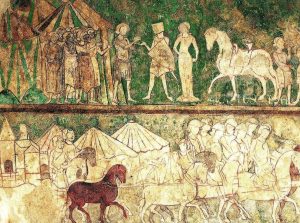
In the Aljaferìa palace in Zaragoza, there are some friezes on the walls which show the story of Jaufre. These were completed in the mid 14th century, and have mostly disappeared now, but there are two still visible, although sadly (on my visit) not marked by any explanatiory signs. This one, the clearest of the two, seems to show Jaufre returning with the lady to the meadow, where you can see the tents, and in the lower, more deteriorated panel, there is the wounded Felon being carried on a litter between the horses.