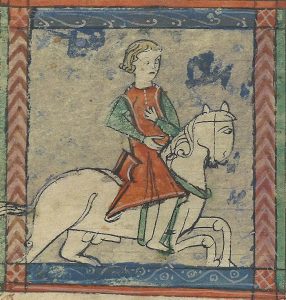
This episode, rather like the last one, is a stand-alone adventure and has no real importance to the main storyline. It’s also quite short, as you will have heard. The main adversary is a highly unpleasant character who seems to have no real purpose in life except to attempt to extort horses and armour from passing knights. He’s quite clearly not, himself, a knight, as he has no horse, quite apart from his distinctly unchivalric method of fighting. He has, on the other hand, acquired horses from the 25 knights he’s imprisoned, and he wants to ensure that Jaufre’s horse isn’t hurt in the fight. In the original text, he’s referred to as a “sirvens” or “serventz”, and this might be translated as a servant, a man-at-arms, or a mercenary soldier. Contemporary accounts use the term “sirvens” for generally anti-social individuals, responsible for such crimes as pillaging, murdering, holding victims to ransom and bullying. I’ve used the term “ruffian” to try to encapsulate all of this. His actions (high leaps taking him from side to side of the narrow canyon) and his weapons (three impossibly strong and sharp darts) suggest that he may be magical in nature, but he is not immortal and can be defeated.
Jaufre’s behaviour isn’t chivalric either, although it could be argued he has little choice in how to respond. It also strains credulity to imagine just how his fighting technique could work. However, he then goes on to inflict a cruel punishment on the ruffian, and the other knights seem to consider it justified – as does the dwarf who had been his servant. The morality is very clear-cut. Bad behaviour results in punishment, and it is of no use to ask for mercy if you are not prepared to grant it. The dwarf, on the other hand, like the dwarf with the White Lance, is not punished as he was coerced into his role.
You will notice that when the rescued knights and the dwarf reach Arthur, who is sitting in an orchard, he is now with a much-depleted entourage of just 21 knights, which means that they are out-numbered by the new arrivals. The Pentecost feast is over, and the great numbers who had been present have now departed. Some scholars have seen this ever-decreasing court at Carduel as representing the decreasing power of the monarchy in general. It’s impossible to rule any theory out, but it seems odd that a story dedicated to a king (and that king explicitly compared to Arthur) should be critical of kingship. aa
Having returned to this story after watching The Mandalorian, I was struck by the similarities. The hero is on a quest, and there are side quests, not all of which have a bearing on the central theme. The hero has acquired invincible armour, which allows him to withstand lethal attacks, and blows to this armour will result in visible sparks and flashes. He has a strong moral code, and sticks with it. I’ll return to these comparisons as the story continues.