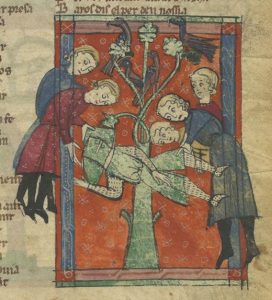
Jaufre has now been travelling for some time, has had a few bruising encounters (literally!) and is now exhausted. Although he promised he wouldn’t stop to sleep before finding Taulat, he really has to, and his horse is in need of a rest as well. Luckily, there’s a beautiful garden with fresh grass behind a marble wall. But of course it belongs to someone.
There are many resonances in this chapter and features that can be found in many other medieval and pre-medieval stories. The garden which seems like Paradise is just one, but those familiar with the Welsh Mabinogion will think of Rhiannon and her singing birds, and those who know Chrétien de Troyes’ “Perceval” will think of his hero, lost in a reverie about his love and dreamily doing battle with various knights while only half-conscious. Brunissen, though, is not Rhiannon, and Jaufre is not in love (at this point) but seriously tired to the point of almost falling off his horse. What I love about this episode is the way in which the author switches from Brunissen and her temper tantrum to Jaufre and his complete befuddlement. It needs very little treatment to see it as a modern film sequence.
Monbrun is, like most medieval “castles” of the time, more of a small fortified town, as you will realise by the description of its inhabitants. When we visited Zaragoza we made a trip to the castle of Loarre, and although many of the buildings within the outer walls are no longer visible it does provide a possible inspiration for Monbrun, particularly with the description of the squared brown stones and the many towers and gates. There is still a small olive grove below the main castle, and you must climb some steep stairs to get inside the living quarters, which (although not unusual) certainly fits the story well. 
Brunissen is not what most people imagine as a conventional medieval maiden. She is rich (fabulously so, as the author tells us that Monbrun isn’t her only castle), and independent. This is a little odd, as later in the story we’ll find someone who may be the overlord we’re told here she doesn’t have, and in later re-tellings of the story that man is described as her uncle. But at this point the important issue is that she is most emphatically in charge and powerful, and when she gives an order, her men jump to obey it. She is of course over-tired, and who wouldn’t be, with this frequent mysterious ritualised mourning? And this might explain her hair-trigger temper. She must also take great care of her reputation, as an unmarried woman. When she talks to herself about whether she should or shouldn’t fall in love with Jaufre or marry him the dialogue is very similar to debates found within troubadour poetry and the writings of Andreas Capellanus, and a 13th century audience would have been familiar with the discussion. It’s not unfamiliar to a 21st century audience, either. You will notice that she is not short on self-esteem. Even an emperor would count himself lucky to have her! You will also notice that she mis-remembers Jaufre’s comments and is very obviously thinking of more than spiritual love. She is, in short, an unforgettable character, and we are given an insight into her thoughts as well as hearing how she speaks. Meanwhile it’s hard not to feel great affection for the seneschal, who can’t resist a small smile at the discomfiture of Simon the Red, and who is doing his level best to keep Brunissen from giving orders she may regret later.
Jaufre is also shown in very human terms, rather than as a stereotyped hero. He is too sleepy to take in what’s happening and is fully convinced that just one man keeps breaking his promise and waking him up. He really can’t understand why there’s all this annoyance when he’s not stealing anything or destroying anything. He thinks the men must be demons or ghosts, because who else would be around in the middle of the night, behaving oddly? Of course he was justified in the more violent response to the third time he’s roused from sleep, because the man was clearly wrong to break his word. When he sees Brunissen, it’s love at first sight, and the angrier she is, the more he loves her. She’s threatening to have him tortured and killed and he doesn’t care. She may be surrounded by demons and ghosts, and in the worst mood imaginable, but she is adorable. The narrator also points out that while she is tossing and turning and tormented by love, Jaufre falls asleep immediately – a phenomenon of female/male behaviour (I apologise if this is too binary) which is instantly recognisable in the 21st century. And then to put the tin lid on Jaufre’s confusion, he’s beaten to within an inch of his life because he asks what’s happening, when he’s woken up yet again by the weeping and lamentations. No wonder he thinks they’re all demons.
I love this episode. From small details such as Jaufre letting his horse graze on the rich grass, 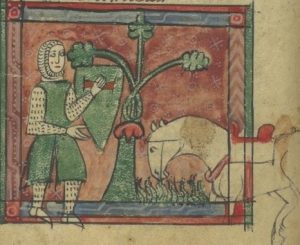 and the wonderful description of Simon the Red going back up to Brunissen with a dusty backside while the seneschal smiles to himself, the image of all of Brunissen’s men trying to stay in her favour by going down to the garden en masse to carry Jaufre up to her, to the moment when the furious Brunissen first sees Jaufre standing in front of her, surprisingly shiny considering the episode which precedes this one, and finally the image of Jaufre riding away but hearing the noise of the lamentation and feeling too confused to go on, while Brunissen gives the seneschal his orders – this is a wonderful piece of storytelling. I hope you’ve enjoyed it, too. And of course it’s far from over ….