Chapter 7, first of all, is very short but full of some fascinating detail. The herdsman and his ox-drawn wagon, waiting in the middle of nowhere in the hope of meeting someone to share his food, thoroughly delighted to meet Jaufre and offer him superb hospitality and excellent food. Nothing is too much trouble. This isn’t a rough and ready picnic – he has a fine white cloth, he has silver goblets, brimming with good wine, he has all manner of fine provisions. They sit in the shade of a tree, and there’s a river nearby where Jaufre can wash his hands before eating. Such warmth, such friendship and such generosity – until Jaufre asks about the mysterious lamentation. And at that point this gentle, welcoming man falls into a murderous rage and is so angry he even destroys his own wagon and oxen. We’ve already heard that Jaufre has been terrified by the grieving at the castle, and was further thrown into confusion by hearing another episode of mourning when he was on the road away, so this transformation would, you would think, further scare Jaufre. But instead he watches the frenzied attack on the animals and laughs.
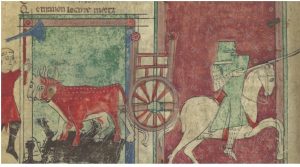
This episode may have been well-known to some troubadours at least, because of a reference in a devinalh (a cryptic poem in which the reader must do some of the work) by Giraut de Bornelh, in which he compares himself to Jaufre. Jaufre, he says, “gets up when he is expected to sleep and sings when he is expected to cry”. Giraut was writing from the mid 12th century and none of his poems are dated later than 1199, so if this is indeed a reference to Jaufre’s escape from Brunissen’s sleeping castle and laughing at the herdsman’s misfortune, it indicates that some at least of the story is earlier than my proposed date of 1225. Which isn’t surprising, as the creator of The Tale of Jaufre almost certainly put it together from various existing stories.
In Chapter 8, Jaufre meets the two young men engaged in hunting with their hawks and hounds, and nothing could be more cordial than this conversation between them. Until the lamentation starts again, and Jaufre can’t stop himself from commenting on it, which once again causes fury. Again, for these two young men it’s a self-destructive anger, in which first a hawk and then a hound are hurled at the stunned Jaufre. One of the delights of working with this text is to discover phrases like “Whatever you have to say, you can say it from over there” in the original Occitan. Jaufre has discovered, though, that he is still in the middle of nowhere, and once his companions have calmed down he has to take a pragmatic attitude, accept their promises of good behaviour and go with them to their home. Which turns out to be the perfect small castle, and their father is the perfect Hospitable Host, cultured (hearing a minstrel singing the Lay of the Two Lovers, possibly from Marie de France) and delighted to welcome a guest. You will perhaps have noticed how often people in the story are referring to “seven years” since they last welcomed anyone. There will be more of these references. There’s also a daughter, never named, who is very beautiful and who occupies herself with taking care of the guest, from bringing him a mantle and a cushion and conversing with him, to serving him with roast peacock at dinner and even making up his bed. It is perhaps predictable that the host, Augier d’Eixart, was the best friend of Jaufre’s father, so that the invitation for him to stay longer is hard to resist. Friendship, welcome, family, hospitality, comfort and even possibly an alternative love interest … but Jaufre is on a quest and won’t be diverted. He sleeps so well this time that he doesn’t hear the lamentations overnight, but of course he has also had a day without any challenges. The next morning again the maiden brings him food, and he is escorted some of the way on his journey by Augier and his sons. Another interesting feature of The Tale of Jaufre is that we are told what Jaufre is thinking (just as we have heard Brunissen’s thoughts), and again, the comment from Augier about Jaufre’s quietness seems surprisingly contemporary. Jaufre has to ask, of course, about the lamentation and mourning, although he knows it’s probably not a good idea and, once again, it provokes a furious reaction. The contrast between Augier’s emotion and his previous geniality is enormous – but this time when he is able to calm down he is finally able to give Jaufre some good information about where he should go to find out more.
In the notes for the next chapter I will say more about what Jaufre finds, and where this part of the story may have come from, but for the moment this episode is full of details of social behaviour. You might want to savour, as I do, the frequent allusions to people washing their hands before eating, the care Jaufre takes of his horse, and Augier offering wine to his guest before he goes to his room to sleep.