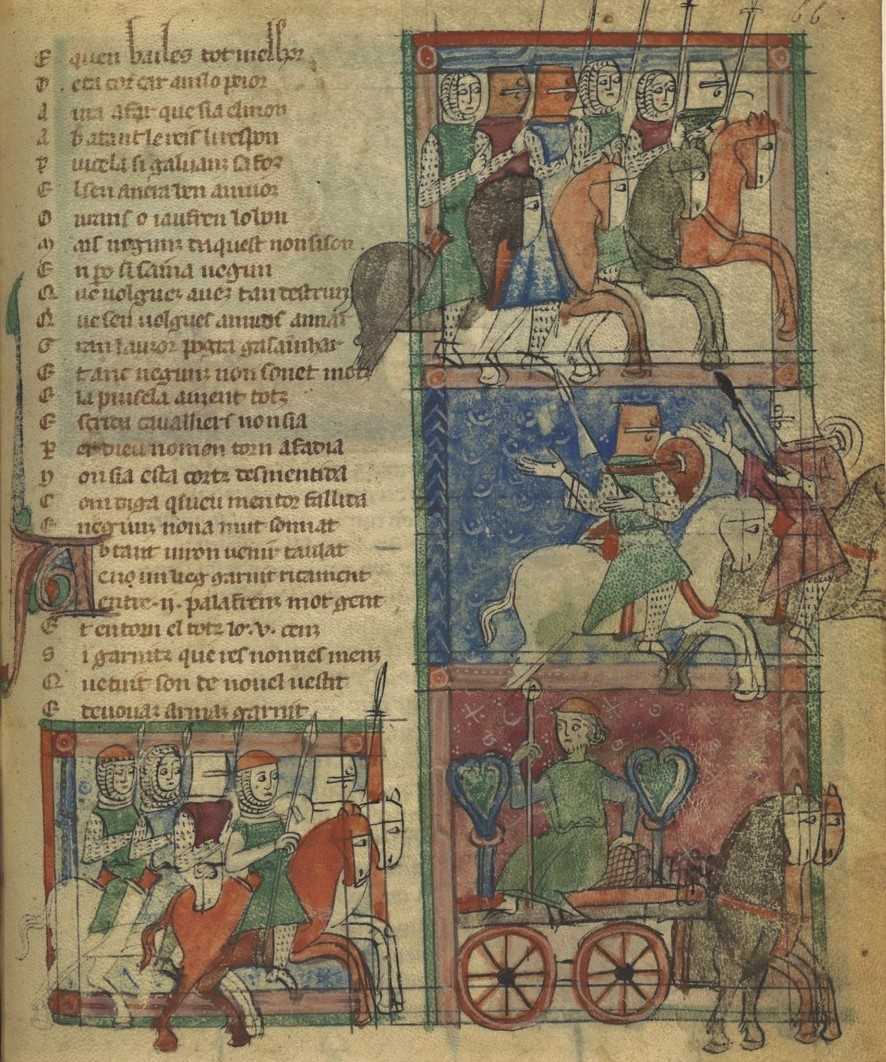
The time has come for Jaufre to meet Taulat. Some scholars have described Jaufre’s progress so far as building up to this point, but he has had no schooling or training in fighting techniques and he has, from the very first encounter, been able to deal effectively with his foes, even if his style can be unorthodox. There may have been a turning point in his battle with the demon in the forest, and he is now certainly more vocal about his mission from God. He has been sent by God in order to punish Taulat’s arrogance, so that a young knight with less than a month’s experience will bring down this ferocious and cruel fighter. Remarkably quickly and easily, in fact.
The interchange between them, both before and after the fight itself, is fascinating. Jaufre starts by giving Taulat every chance to avoid the confrontation – all he has to do is stop torturing his prisoner, after all – but Taulat is used to these requests (as shown by the number of captive knights camped around his castle) and he is unwilling to believe that this young upstart is any challenge to him, even to the point of choosing not to wear full armour. This means, inevitably, that he will be brought down in the way he had described bringing down Jaufre.
There is a huge contrast between the description of him riding into the combat “like a leopard” and then being sprawled on the ground, skewered by Jaufre’s lance “like a toad”, just like the contrast in his words to Jaufre. Taulat surrenders immediately, hoping for further mercy in terms of medical assistance, while Jaufre prolongs his victorious moment by reminding him of just how ignominious his defeat has been.
Back in Carduel Arthur’s court is still decidedly diminished, and those knights present are not keen to volunteer for any chivalric adventures. A maiden is beseeching Arthur for assistance (and the audience for this story has been repeatedly assured that no one ever came to Arthur’s court for help without being supported). Arthur points out that his best knights are not present, as if this was some kind of excuse, but the distressed maiden’s plea for help falls on deaf ears. The narrator repeats the phrase “and no one said a word”, and then Taulat and the man who had been his prisoner arrive, with all the well-equipped freed knights, while the maiden receives no help whatsoever. In fact, she disappears from the scene entirely.
The question of justice and fairness is an interesting one. Jaufre has said that only the king and queen can forgive the insult to the king and queen, and Arthur reminds Taulat that his behaviour was outrageous. The king is, however, minded to forgive when he hears how Taulat declares himself to be thoroughly reformed and humbled by Jaufre. The queen and her ladies are summoned to help determine what else should happen. The wounded and tortured knight reminds everyone that forgiveness is another matter when it comes to a personal experience. He himself could forgive Taulat for killing his whole family, but what he is not prepared to forgive is the humiliation and torture that he has endured over seven years. There’s a suggestion in this of an early acknowledgment of PTSD – the way in which the torture has gone deep into the mind, scarring more than just the body. On a lighter note, there’s what may be a reference to an episode in the First Continuation of Perceval, in which a dwarf throws a roasted peacock at Sir Kay because of Kay’s behaviour. I’m saying “may be” because only one of the two manuscripts uses the word “paon” for “peacock” while the other refers to a “baston”, or stick, but in any case there’s a reference to an adventure concerning Kay and his forgiveness of an injury which was not only relatively slight but also possibly deserved. The tortured knight emphasises that this is not the same situation, but this also gives him the chance to remind Kay that Jaufre has not forgotten or forgiven Kay’s insult to him. The whole scene shows a fascinating glimpse into how justice may have been administered, or could be administered, with a hundred men with legal training called in to determine what should happen, and the final decision that Taulat should be made to suffer what the tortured knight has suffered. No more, and no less.