This episode is another stand-alone adventure, and it has proved to be very important for some of my experimentation with telling the story to audiences. There are a few significant points:
The encounter with the distressed young squire, and the even more distressed mother, demonstrate Jaufre’s wish to be completely clear about the reasons for getting involved. Jaufre is extremely tired, and he seems unable to take in what he is being told. He’s also unwilling to sympathise with the squire’s fear. As a storyteller, injecting some animation into the words from the page, it is almost impossible not to portray the contrast between the two men, and there is a degree of humour that comes from that contrast. I also love the way that the squire explains how he doesn’t have time to tell the story of what happened, and then tells it anyway, in some detail. As for the mother – who wouldn’t feel sorry for her? Well, Jaufre, it seems, who has to cross-question her about the motives of the abductor, and then, rather less than reassuringly, says he will return her child “dead or alive”, once he has decided she is in the right.
Lepers – this is from a time when leprosy was seen as a punishment from God. Lepers were seen as intrinsically evil, and lecherous. The description of the giant leper is apparently medically accurate, and there was a suggestion that bathing in the blood of the innocent (such as children) could be a cure. The leper who is stealing children has also compounded his evil by making an insulting gesture to Jaufre, whose sense of morality is, as we have seen, very simplistic. Jaufre is, therefore, attacking the giant leper to save the beautiful maiden, and fighting in whatever way he can (modern listeners will of course recognise how this precedes Monty Python), and then attacking the other leper to save the children. Modern listeners find this all difficult, but this was from a different time, and when the maiden tells her story to King Arthur we realise the giant has behaved brutally as well.
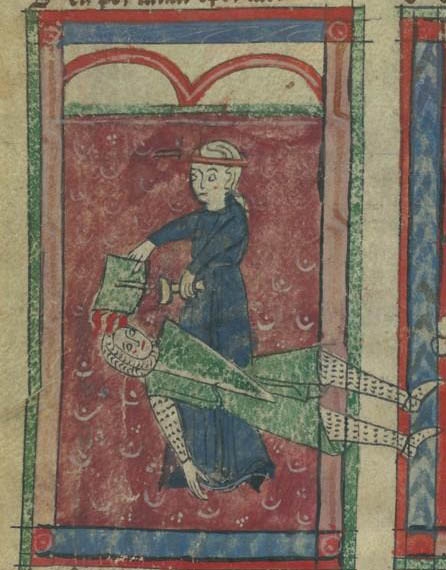
The maiden, you will notice, is quite remarkably practical, using Jaufre’s helmet to fetch cold water to throw over the unconscious hero. He is still dazed and confused when he revives, and she has to reassure him, and remind him of where he is and what has happened. It is lucky, though, that he has dropped his sword or he might have committed one of the worst possible crimes for a knight and killed the maiden in his confusion.
Jaufre’s mood and thoughts are unlike a stereotypical hero. Having dealt with the giant, and been assisted to regain consciousness, he falls into despair when he realises he can’t leave the house or find the children, and he laments to God that he has ever become involved in this situation. He can’t do anything about a magical spell. It’s at this point that there is an odd interjection by the narrator, who leaves the story to address the audience and complain about contemporary society. The digression takes a while and jolts the listeners out of the fictional narrative. In live performances I have used this to complain about someone talking at the back of the room, or Brexit, or the government, and each time I have seen people look astonished and wonder what is going on. I’m still unsure what this passage is there for – whether it marked a real break in narration, or whether there was some contemporary event to spark the initial comments – but both of the complete manuscripts include it, so copyists must have considered it important enough to include. (It is thought, by the way, that stories were told largely from memory, and it is not clear whether the original “author” ever made a physical copy of their work. Scribes were able to write swiftly using wax tablets, and that is the most likely way for them to have been recorded.)
The business with the enchanted head has kept scholars excited. Many magical spells or magical characters are accompanied by the sounds and effects of storms, and this is a wild one! There is a Breton tale in which a giant’s castle is reduced to rubble in a similar way, although of course it’s impossible to tell how old this tale is. Astute listeners will spot the plot hole, in which the maiden, the mother, the leper and the children are somehow spared the effects of the collapsing building while Jaufre has it all on his own head, quite literally, but that’s storytelling for you.
You will notice as well that Jaufre is fully aware of the practicality of getting everyone to King Arthur, to prompt the leper into returning the maiden’s palfrey and mantle.
It is a fascinating episode. I hope you enjoyed it.